
I’ve been using this note-taking system for a while, and it helps me keep track of feedback (both good and not-so-good) and makes sure I don’t forget those moments when someone really shines or needs a little nudge in the right direction.
But first things first: you do not need to follow any of this—seriously. This system works for me. If you like it, steal what you want and tweak it to your own style.
How
This process can be summarized into two simple steps: gathering and processing.
Gathering
- Whenever I see something worth calling out on Slack (or elsewhere), I jot down a quick note.
- It can be something big or small, positive or negative—no matter the impact, I note it if it feels worth mentioning later.
Processing
After collecting notes, I divide them into two categories:
- Needs immediate discussion: If it’s something that shouldn’t wait, I’ll bring it up in the next 1:1, or maybe just drop a quick DM on Slack.
- This way, feedback isn’t delayed, and my reports get a chance to act on it right away.
- Can wait for performance check-in: If it’s not urgent, I’ll hold onto it for our biannual performance check-in.
- By the time the official review comes around, I’ve got a bunch of historical data. This helps avoid recency bias (when all you remember is what happened last week).
Log
I use a simple (Notion) table to capture everything. Here’s more or less what it looks like:
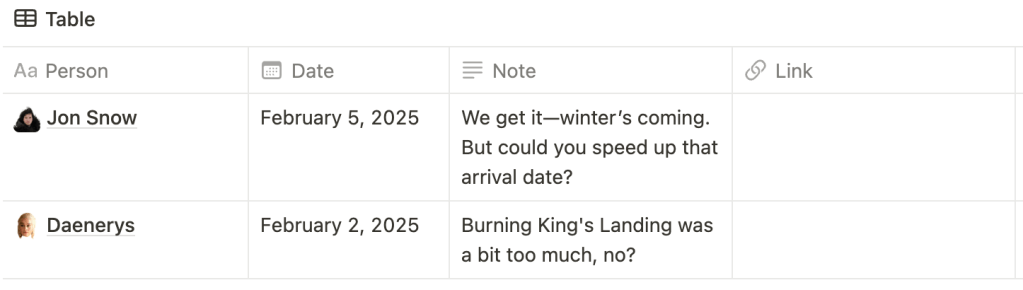
- Person: Whoever the feedback is about.
- Date: When the feedback was noted.
- Note: A short blurb about what happened.
- Link: The evidence. Maybe it’s a Slack thread link, an Asana ticket, an interaction on GitHub, etc.
I keep this table in Notion, but you can totally do it in Google Sheets, a Trello board, or wherever else works for you.
Philosophy
Take notes. Not too many. Mostly positive.
(Inspired by Michael Pollan’s “Eat food. Not too much. Mostly plants.”)
That’s the simple guideline I follow:
- Take notes: Write it down so you don’t forget.
- Not too many: Don’t drown yourself (or your report)—focus on what really matters.
- Mostly positive: People tend to thrive on encouragement (but don’t shy away from the occasional reality check when needed!).
That’s it—hope it helps.
 Terrible Software